JOURNAL
Notes from the field, studio and curious places in between.
Observations, work in progress, natural history rabbit holes, expedition stores, ideas and experiences that surface while in the pursuit of creative and curious adventure.
Rejection—Professional vs. Personal
I know not all creations make it out into the world to be shared, but we must still create them. I know rejection is not a four-letter word but I always say lots of four-letter words when I get one. It’s been one of the biggest challenges I’ve faced as a professional artist and creator, because I take rejection so personally. I understand at a very intellectual level that to be rejected is more about the other person but at an 8 year old emotional level, it always leaves me feeling sad, mad and hopeless.
INTERViEW ~ Antarctica, Science and Art
Storytellers of STEMM Podcast #111
created by Rachel Villani
Today's storytellers are Kirsten Carlson and Greg Neri! They are co-chairs of the Antarctic Artist and Writers Collective (AAWC), and they went to Antarctica together as part of the National Science Foundation (NSF)'s Antarctic Artists and Writers Program in 2017. The AAWC brings together all past members of the NSF program together to collaborate to inspire and educate the public about Antarctica. Right now the AAWC has an online exhibit called "Adequate Earth" and you should definitely check that out because you can also see the exhibits that Kirsten & Greg contributed! Kirsten is a visual artist, has a science background, and a diver and she combines all of these things together in her work. Greg is a writer and filmmaker, and has written a dozen books for kids about various topics. They are both awesome and it was so great to talk to them and hear about their time in Antarctica, their work with AAWC, and their exhibits in the Adequate Earth online program. Enjoy!
Rachel Villani
Twitter @flyingcypress
Storytellers of STEMM on Facebook •Twitter @storytellers42.
Greg Neri https://www.gregneri.com/
Twitter @g_neri
Antarctic Artists and Writers Collective
Twitter @AntarcticAWC
https://www.aawcollective.com/.
Adequate Earth by AAWC: https://www.aawcollective.com/adequate-earth-exhibition
Rachel's Outdoor Conservation Book Club
https://www.goodreads.com/group/show/741391-outdoor-conservation-book-club
Book List
The Invention of Nature by Andrea Wulf
The Adventures of Alexander von Humboldt by Andrea Wulf
Endurance by Alfred Lansing
WEBiNAR ~ Tales and Pictures from Antarctica
This week I’m doing a webinar with fellow Antarctic Artist and Writer, Karen Romano Young. The event will be live and the recording will be available on the AAW Collective website under Adequate Earth Events. It is hosted by SUNY Cobleskill and moderated by Dr. Andrew Gascho Landis.
Science communicators have a crucial role in making innovative research conducted on the “continent of science” known and accessible to the public. Deploying multidisciplinary artists who have a specific interest in creating materials and projects that speak to audiences and actively promote the understanding of scientific research in Antarctica has become an essential focus of the National Science Foundation’s Antarctic Artists & Writers program over the past two decades. In their projects, Kirsten Carlson and Karen Romano Young combine illustration and writing to create stories about scientists — their research and their ground-breaking findings. Carlson and Young will present their internet-based projects Fathom Antarctica and #AntarcticLog and discuss their work as mediators between scientific research and the public.
BIOS
Kirsten Carlson is a scientist, graphic artist, and writer based in Stuttgart, Germany. She creates illustrations, posters, and books to educate and inspire the public about ocean research and conservation. Her writing and illustration have been featured in the Census of Marine Life, Monterey Bay Aquarium Research Institute, MUSE Children’s Magazine, and as part of a juried exhibit in Washington D.C. at the headquarters of the American Association for the Advancement of Science. Carlson was a participant in the Antarctic Artists & Writers Program in 2017. She is co-chair of the Antarctic Artists and Writers Collective.
Karen Romano Young is a writer and illustrator, the author of more than two dozen books for young people. Her work in education and outreach has taken her to museums and aquariums around the country. Young has accompanied research cruises in the Arctic for the NASA ICESCAPE mission, in the Antarctic for the International Ocean Discovery Program, and the Pacific for the Extreme Project and Nautilus Live. In 2017, she started her weekly science comic #AntarcticLog as a participant in the Antarctic Artists & Writers Program. Romano Young is currently writing a book about the history and science of Antarctica and a graphic non-fiction book about the deep sea.
Andrew Gascho Landis, Ph.D. is an assistant professor of Environmental Science at the State University of New York at Cobleskill. He earned his Ph.D. from Auburn University in Aquatic Ecology, M.S. from Northern Arizona University in Forest Ecology, and B.A. from Goshen College in Biology. At SUNY Cobleskill he relies on his diverse education and experiences to teach a wide range of courses including Ecological Restoration, Watershed Management, Forest Ecology, and Hydrology. His research focuses on the conservation of freshwater mussels and ecosystem restoration.
The Iceberger
When I saw the call on social media last month about drawing icebergs, in their stable orientations, I was overjoyed! This is a wonderful example of why and how science communication works. It started with Megan Thompson-Munson tweeting her passionate petition for proper rendering of iceberg orientations.
It doesn’t matter how long I’ve been a scientist-artist, there is always something new to be learned, mistakes to be made, facts to be fathomed. I love being a science communicator because of my passion for connecting with the beauty and wonder of Nature and sharing it with others. I find ways to be inspired by the Universe everyday. There was no doubt in my mind, I had to fix my art to reflect this new bit of knowledge.
I took my Tip of the Iceberg illustration with an oh-so-wrongly oriented iceberg and used the program, the Iceberger, that Joshua Tauberer created after being inspired by Megan’s tweet to correct the floating position of my little bergy bit.
It took me a couple tries but I got the basic outline of my iceberg in the program and then watched it slowly rotate to this new orientation. It is super fun and a bit addictive to try out different shapes!
Free Store Monday
FREE STORE MONDAY! I created these six scratchboard illustrations for an education poster project I collaborated on with the Monterey Bay National Marine Sanctuary. Download all 6 posters for free: https://montereybay.noaa.gov/educate/tt/welcome.html
The originals are still for sale (contact me here).
@MBNMS #fathomitstudios #threatened #thriving #sealife #sealifeart #montereybay #scratchboard #scicomm #sciart #MarineLife #ElephantSeals #seaturtle #jellyfish #whale #seaotter #kelp #scubadive #underwaterartist This post inspired by my #100dayproject
Throw Back Thursday 2010 • Milestones • Drawing Underwater
I've hit a big milestone in my career.
I’m part of a group online exhibition with 12 other artists and writers that have gone to Antarctica, like me, as part of the National Science Foundation Antarctic Artists & Writers Program.
#TBT 2010 ~ I was in a group show with 29 other female artists, featuring nature journals called, Drawing on Nature. That was the first time I exhibited my underwater drawings and talked about taking my field sketching tools underwater.
A big shift happened for me between the 2010 exhibit and my current group show, Adequate Earth: Artists and Writers in Antarctica featuring five drawings done underwater in the Ross Sea, Antarctica.
Connecting people with the beauty and wonder of Nature was a epiphany I had in Antarctica in 1992 as a marine ecologist. I dropped out of graduate school and transferred to the Science Communication-Natural Science Illustration Program led by Ann Caudle and Jenny Keller.
I went on to be a designer-illustrator at Monterey Bay Aquarium for 10 years, left for love and have been freelancing ever since, developing and refining many skill sets to best share the Natural World (which is mostly ocean-inspired with the odd bird thrown in).
Field sketching was a wonderful method I learned and it very much engaged my scientific tendencies. I took my field sketching tools underwater starting in 2006, was part of an exhibition about journaling in Nature in 2010 and two weeks ago, an online group exhibition launched featuring 5 (of 22) underwater sketches I did diving in Antarctica transformed into art using ProCreate.
The journey is in no way over...it took almost 30 years for me to get to what I think was my real quest all along, Share the amazing undersea world of Antarctica with others.
Visit my work in Adequate Earth to find out about my transformation.
It's online through May 22nd and beyond. I'll also be giving a presentation with fellow #scicomm #kidlitauthor #kidlitillustrator Karen Romano Young on March 18th.
To see my Antarctic Undersea Illuminations visit: https://www.aawcollective.com/adequate-earth-exhibition
To register for the presentation by Karen and I, Tales and Pictures from Antarctica: Diving under the Ice and Climbing Glaciers for Science Communication, visit: https://www.aawcollective.com/adequate.../tales-and-pictures
Seaspider Saturday
My first ever underwater encounter with a HUGE Antarctic Sea Spider led to writing and illustrating an article for a newsletter I used to design called the WAVE.
Thank You Letters!
I love getting thank you letters, I’ve kept them all. Recently, I decided it was to start digitizing documents and I came across these. Reading them gave me such a warm fuzzy!
I taught a class in 2001 to 7th and 8th Grade girls. It was called Creating Art in Science and my goal was to make sure they knew that combining science and art was not only possible, but super fun! I came across some of the thank you notes today and had to share. They are all women in their 30s now, wow!
In Honor of 2020 Giving Tuesday!
The 7 Facets of Field sketching
Taa daa, my newest infographic. Field Sketching (whether above or below water) is a practice exercise, it slows you down, uses all 5 senses, reveals patterns, engages language, and it's a path of discovery that inspires curiosity. I’ve been teaching fieldsketching off and on over the years and this is the illustrated version of a sketch I did from a few years ago.
I’m sharing something I've developed during my field sketching quest to share the beauty and wonder of nature with others. Happy #givingtuesday !#artistsoninstagram #underwaterartist #fieldsketch #fieldsketching
INTERViEW ~ Tips for Scientists on Working with Artists
There’s a new online resource for scientists, and it’s called Lifeology.
Lifeology | The place where science and art converge
Lifeology is a platform that brings together scientists, artists and storytellers to helping all people better understand and engage with science.
I was lucky enough to see their call to artists on Twitter and added my two cents to their article aimed at educating scientists about working with artists. It’s such a hugely important topic and this article is great for both scientists and artists.
My favorite interview questions was: What are some common basic questions that scientists have for you when the collaboration first gets going? What are some common misconceptions or lack of
knowledge that they have?
My Answer:
I’m as much an educator in sharing the process of creating, as much as I am the creator making the work. I also
often ask what the budget is up front because then I can tailor details like size, timeline, usage
rights, medium to the project. I learned that it’s incredibly helpful to provide a project contract
that scientist and I both sign which includes timeline, deliverables, payment, sketches etc. I
believe in long term collaborations (lifetime even) and I usually get involved because I’m
passionate about the subject and excited about the science and interpreting it visually. The
biggest misconception I would like to dispel is that we can/want to do the work for free, or for
exposure, or [fill in the blank]. I do pro bono work but that circles back to wanting to build long
term relationships.
Read the whole article: https://lifeology.io/how-do-i-work-with-a-sci-artist-15-artists-answer-scientists-qs/
Discovering a Doppelganger
“Now, what would be the odds of that?” I said out loud, channeling the voice of Judi Dench’s character from Chronicles of Riddick.
I did a double take when I spotted this diorama of a polar bear & seal. It was the last thing I expected to see in the Polar Regions Exhibit at the Natural History Museum in Stuttgart. Here was a taxidermy mirror image of my illustration.
I decided to think of it as analogous to convergent evolution, where two organisms have different origins but end up looking similar. But this is creative convergence. Polar bears, do after all, eat seals. They have a certain way of hunting them that both the museum and I captured. I like exploring relationships in nature and discovering this doppelganger was a bit of a double discovery!
Want to own the original art? It’s available for $1000 (+shipping), framed 12 x 15 inches (pictured above)
Arctic Greeting Cards are available for $2 each. Ten cards on sale during the month of March for $12!
Becoming an Author
I’m exploring my roots as a writer. My first news story was published my senior year of high school. I authored two articles in one month—both written in second person (mostly). Not sure I would ever write from that POV (Point Of View) again…. This feature story summarized my two week exchange trip to Germany in 1986, before the Wall came down. The experience changed me forever, and made me into a world explorer. The story is unedited, aside from a few apostrophe typos that I can’t let slide 34 years later. There is so much my17-year old self left unsaid, enjoy as I am pondering whether to write a Part II.
44 Students Experience Deutschland
Friday, April 4, 1986
Germany…Bach, beer, castles, Hitler, the Berlin Wall, and Boris Becker. Those are some things Americans identify with Germany, but few have had a chance to live “behind the scenes.” What if you could see what it is like to speak, eat, and live with a German family?
Forty-four American students and three teachers had the chance. High school students from Kansas City, Minot, ND, and Renville, MN, traveled with ISE (intercultural Student Experiences) for a two week stay in Germany from March 5-20.
The impact of where and what was happening did not really occur to the students until the second day in Germany, after a day of traveling through East Germany to get to West Berlin, the jet lag still lingered two days after arriving in Germany. Anyone could see the looks of anxiety, fear, and exhaust on the faces of the 44 American students on the bus as it pulled up to the school where each student would meet a family and disappear into West Berlin for a week.
Anxious faces waited outside the bus as the names of students were read. One by one, each student went down the steps to meet his or her new family.
The family was standing by the bus entrance, everyone smiled nervously, shook hands, and exchanged hellos. They worked their way through the crowd, the Americans catching glimpses of other students very few minutes, no one wanting to leave the security of the bus too quickly.
Some people did leave quickly, some stayed until the bus was empty, but everyone soon realized that were on their own.
The car ride home was quiet; it is very hard to start a conversation when you have to speak a language that succeeds in making you sound like a five-year-old and you have a bad case of jet lag that will not allow you to concentrate, so you do not understand a thing they are saying. That first night was frightening, answering questions in German and ignoring waves of exhaustion sweeping over your body was next to impossible.
Waking up in a strange house is like waking up from a dream but instead of being a dream, it is real. Lying in a room in Germany, you wonder how to say, “Are you awake?” to your German sister, Andrea.
Finally, you notice that both of you are awake. You smile, wondering how much time you wasted thinking about three words when all you really needed was a smile. During breakfast several efforts are made to start a conversation. It ends up being very one-sided, answering their questions with nods or shakes of your head…but it is a start. Out of the whole conversation you figure out that her friend also has an American staying with him and the four of you will spend the day seeing Berlin.
The other American was one of the people you only met briefly on the bus, buy you are joyous that there is someone you can actually speak English to. After speaking to each other for a few seconds, you realize that your sister and his brother have very quizzical looks on their faces because you are speaking too fast and everyone bursts out laughing.
People from every walk of life live in Berlin. People with orange hair and leather jackets, fur coats and diamond rings; cars that look like lawnmowers, Porsches, Mercedes and BMWs populate the street. Shops are everywhere; McDonald’s and Burger King are as common in Germany as in America, one on every block.
Ordering a cheeseburger, French fries, and a Coke is common too, but it sounds like you are insulting the English language. It sounds like: burga mit kayza, fritts, oont a gross coke (not very appetizing).
Some of the fashion of the German guys at the high school I went to for a week.
By the end of the day though, you have succeeded in forming a language which is a mixture of German and English, you say the things you know in German then substitute English words for the words you do not know in German and hope that someone will get the idea.
That night you are dragged to a discotheque, visions of John Travolta and white suits on a dance floor fill your mind, but it is the opposite. It is a permanent party. Teenagers meet, dance, and have fun. Loud music, smoky air, lights and noise make it a teenager’s world.
Another world for the teenager is school, but in Germany it is a place just to learn, no pep rallies, football games, rooms or clubs. School seemed very dead; the school was large and the population was very small. Students usually had four classes a day with twenty or thirty minutes between classes and a 90 minute lunch. You notice in the classroom that most students do not pay attention in class.
Though understanding German was difficult and confusing, as it grew closer to the day to leave, everyone found themselves wanting to stay. In the short span of a week you became friends with your family, and it feels as though part of you has become German forever. For many students, the day everyone had to get back on the bus was going to be worse than leaving the United States because you might not ever see these people again, forever.
The day came, the faces that had been filled with fear and anxiety one week ago were now full of sorrow and love for their “second families” as the bus pulled out of the school parking lot and on the road to West Germany for the rest of the tour as a group.
It took two hours to pass through the West Berlin/East German border, which was a total of about 200 yards. You sometimes wonder how the West Berliners can survive in the middle of east Germany. While traveling through East Germany, a thick fog enveloped the bus. It almost seemed as though it was purposely blocking the view of a communist landscape.
Out of the reach of the fog, inside the bus, everyone was trying to get used to speaking English again and telling tales of their families. It was like a miniature, traveling America. American books, American music, American games and ENGLISH conversation.
For the next part of the trip, everyone saw Germany like a visitor would, instead of from a native’s point of view. In Berlin, natives saw the Wall differently than tourists.
View of the Brandenburg Gate from West Berlin.
The Wall separates Berlin into West and East; it divides the people as well as the land. One of the days in Berlin all the American students took a guided bus tour of East Berlin, a VERY guided tour.
View of Brandenburg Gate from East Berlin.
You only saw East Berlin as the East Berlin government wanted you to see it, but we saw the faces of the people. Solemn, devoid of all feeling‚ except for a glimmer of curiosity at seeing a group of Americans enclosed in a glass bus, separated from their world.
In the memory of those that tried to get across the Wall and failed. East German guard tower in background.
Forty-four students saw Germany as no one else did. From “behind the scenes,” to a tourist’s view. No one will forget those two weeks, the friends, the teachers, the unforgettable families, and most of all, the experience of actually living in another country.
Drawing Under Ice
I was a National Science Foundation grantee in the Antarctic Artists and Writers Program in 2017. I spent seven weeks at McMurdo Station, during which time i did over 30 dives and drew while diving under the ice.
I was thrilled to share a bit of my “Story” and write and illustrate the feature story AND create the cover for the January 2019 issue of MUSE, a science and arts magazine for curious kids ages 9 to 14. The entire issue is devoted to "Life in the Coldest places on Earth." My feature is entitled Drawing Under Ice: Exploring sea life in Antarctica as a scientist & artist.
Three Books & Four Winners!
Luckily, Alanna and Sadie are going to share a copy of the book, but they each get their own bookplate. Thank you to everyone that participated, I loved ALL the entries!
December Giveaway!
Win a Free Book!
Coloring Contest with 3 Winners!
Please color and email a finished jpeg or pdf file to kc@kirstencarlson.net with the subject: Luminous Giveaway.
Deadline: December 15, 2019
No age limit for entries.
I'm celebrating the release of my newest children's book with a Coloring Contest Giveaway! I will pick my three favorite entries to receive a copy of: Luminous Finds Her Aura, Written by John Heine, Illustrated by Kirsten Carlson. In honor of #givingtuesday to everyone who loves stories, the deep sea and crayons (and/or coloring medium of choice)!
Adding Some STEAM to the 24th Annual Science Symposium for Girls
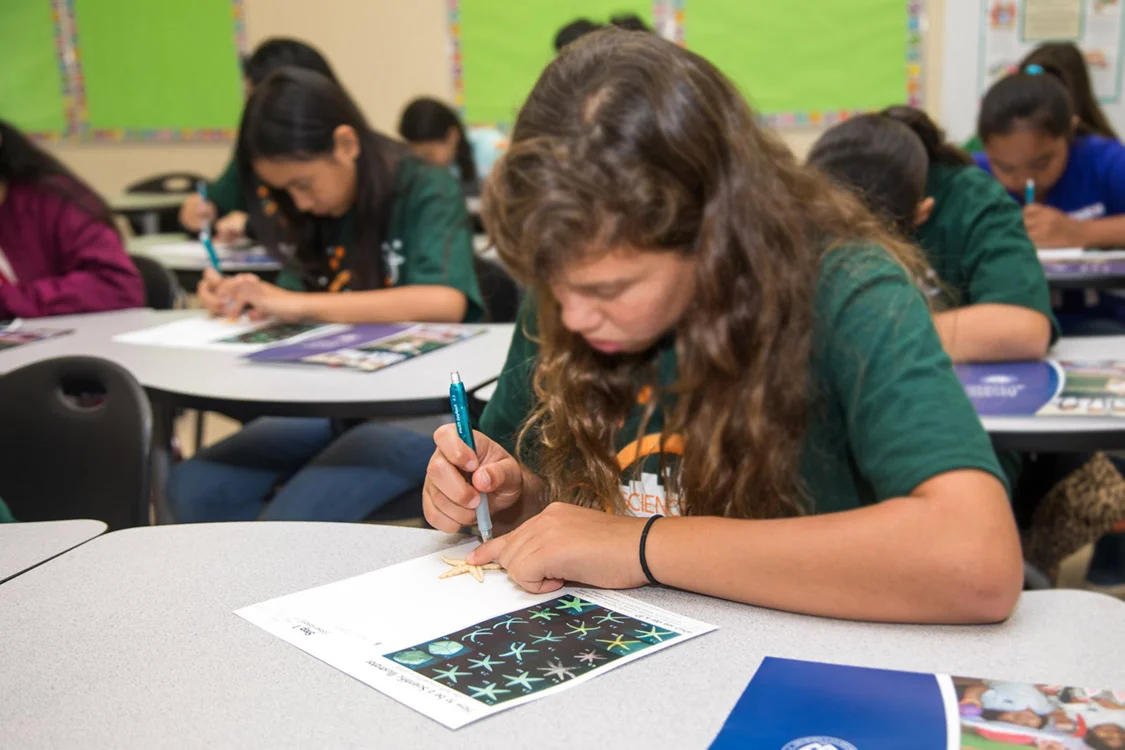
Today, I introduced 5th to 8th grade girls who attended one of my two 50-minute workshops to the basic skills used by scientific illustrators. The girls used sea star specimens to develop their abilities as scientists and artists, side by side. My 3 Step Sci-Art process demystifies drawing and awakens the ability to see the world in a whole different light.
Step 1: Observe & Record
Step 2: Filter & Interpret
Step 3: Create & Connect
Sacred Hearts Academy and a dozen Hawaii-based businesses brought 20 men and women together to share their STEaM careers at this free event. I was honored to be invited to participate because it was an opportunity to mentor the next generation of female scientific illustrators!
Find out more about the free symposium held annually every February: http://www.sacredhearts.org/science-symposium-2018-facts
Good Morning, Antarctica!
This is the view of McMurdo Station from the front door of Dorm Bldg 208. Each day*, I took a moment to take a couple deep breaths (sometimes through a neck gator) and photographed my daily view of Antarctica. The weather dictated the temperature, the clouds, whether the ground was dirt, ice or snow, and the visibility of the ever-present sun. The soundtrack sample is from Ian Tamblyn - Musician, Adventurer and Playwright , a creative musician from the same research trip I was on in 1992. His CD: Antarctica ( https://www.amazon.com/Antarctica-Ian-Tamblyn/dp/B00007LL3I ) was still available at the McMurdo Station General Store. Even after 25 years, hearing Ian's music inspires and captures all the emotion of this magnificent place. [*30 of 42 days]
View this project on Fathom Antarctica, my online megaphone for sharing Antarctic-inspired SciArt creativity with you.