JOURNAL
Notes from the field, studio and curious places in between.
Observations, work in progress, natural history rabbit holes, expedition stores, ideas and experiences that surface while in the pursuit of creative and curious adventure.
Hanauma Bay
There's this amazing place on Oahu called Hanauma Bay Nature Preserve, where most tourists go snorkel with fishies. It's a great spot for all levels of ocean explorers because the fish are big, the waters fairly calm and volunteers share their knowledge about the sea and its inhabitants with visitors.
On Thursday evenings, they do a free public lecture, the Hanauma Bay Education Lecture—a great place to hear scientists talk about their research. They even live stream it so you don't have to be there in person! Check out their YouTube page to watch past presentations.
Tonite was a presentation by my fellow Moss Landing Marine Laboratories alum, Allen Andrews. He's dedicated his career to exploring how to age fish by their otoliths (ear stones) and has come up with some very innovative ways to measure it. Otoliths, up close look similar to a cut through a tree trunk with growth rings, and in a similar way they are counted to calculate how old the fish was when it died. Allen also uses the radioactive signature from non-underground nuclear testing (above ground testing was conducted from 1945 to 1980) and he's developing a method using a laser!
Otoliths, also known as ear bones, reside in the inner ears of all vertebrates. They are important for balance, movement. We have two, fishes have three that aid them with balance, movement and hearing.
The three types of OTOLITHs:
- Sagitta: The largest of the 3 pairs of otoliths, sagitta is involved in the detection of sound and the process of hearing, or converting sound waves into electrical signals
- Asteriscus: This type of otolith is involved in the detection of sound and the process of hearing.
- Lapillus: This type of otolith is involved in the detection of gravitational force and sound (Popper and Lu 2000)
Above otolith description is an excerpt from
: [http://myfwc.com/research/saltwater/fish/age-growth-lab/aging-fish-otoliths/]
I sketch noted his presentation, he uses the data from nuclear testing to validate age-growth in different species of fish, I learned there are THREE pairs of otoliths...I started wondering why and how that helps them. He also shared details on his work using lasers to sample from otoliths.
Write here...
Next month I'll be one of the Schmidt Ocean Institute Artists sharing the amazing journey into science and plankton sailing across the Pacific from Honolulu to Portland earlier this year! Tune in or come in person. In person folks get extra bonus show-n-tell at the end!
Opening Reception for Mixed Media Miniature XIX Group Art Show!
I’m excited to have my work up at the Koa Art Gallery! This is my third art show since moving to Hawaii. The show dates are: Thursday, October 17th – Saturday, December 17th, 2016. The title of my piece is Fieldsketching on Scuba, mixed media, 10 3/8 x 10 3/8 inches. I tinted a print of an underwater drawing I did in Fiji while diving from the Nai’a and augmented it with the following sketch note:
I sketched this fish during one dive. The original piece is on waterproof paper done in graphite. Neither it (the fish) nor I moved much during that 55 minutes. I filmed it with my Go Pro and included the process in my fieldsketching underwater video. They, the Common Lionfish, Pterois volitans (not native to Hawaii) can grow to 15 inches/38 centimeters in length.
The opening reception was Thursday, November 17th. and I met many of the artists and admired the work. Unfortunately, I didn’t get a photo of every piece. Below are a few of my favorites, and a shot of the wall with my work and its neighbors. One artist I was thirlled to see, was someone who’s been a mentor and also happens to make the most charismatic ceramic characters on the planet, Esther Nowell. I fell in love with one of her pieces—a little hen on a tree stump. It jumped into my hands and I took it home. I get to smile at it every day at meal prep time. Thank you Esther!
This video showcases me drawing the lionfish and a bit more about the things I sketched while diving in 2010-11 in Fiji.
Dr. John Randall, International Society for Reef Studies (ISRS) Darwin Medal Recipient
Sketch book notes from the 2016 Darwin Medal Award presentation by Dr. Jack Randall. For more information about him at the Bishop Museum visit
He's probably named more fish than you've eaten in your lifetime.
Dr. John (Jack) Randall (Bernice P. Bishop Museum, Honolulu, Hawaii) received the lifetime achievement award from ISRS this year at the 13th International Coral Reef Symposium. He invented the wet suit before Cousteau, he's described 815 new species of fish and started his career 70 years ago. We heard him speak about some of his experiences, some of which are captured forever in my sketchbook. I first glimpsed some of his holotype specimens at the Bernice P. Bishop Museum when I learned that rows upon rows of preserved fish had his name (as the scientist who discovered them). He is a legend in the fish world. In March 2016, Hakai Magazine published an article title Dr. Fish about his life. as a dive pioneer and dedicated taxonomist.
He is aptly named Dr. Fish. In the Bishop Museum collections, his name appears frequently on the holotype specimens of described fish species.
What Happened at the Most Important Session of the 13th International Coral Reef Symposium (ICRS2016)?
I took copious notes in my sketchbook.
Morning Opening Session: A Facilitated Discussion on Specific Actions for Addressing Climate Change and Its Impacts on Coral Reefs
Date: Friday, June 24th, 2016
Time: 08:00 - 09:00
Location: Hawaii Convention Center, Kalakaua Ballroom A/B/C, Honolulu, Hawaii
Panel:
Moderator: Dr. Robert Richmond
Challenge: Developing a blueprint, road map and timeline for the Coral Reef Science and Policy Communities.
- - - - - - - - - - - - - - - - - - - - - - - - - - - - - - -
Visual note taking is one way to remember the details of a presentation— mine are usually text heavy with doodles. If another person reviewed my scribbles, it might have a chance of making sense to them. Their primary purpose is to record moments I want to remember forever.
Dr. Richmond introduced this session as the most important session of ICRS because it five scientists were going to speak about the future of coral reef communities and conservation. Each person on the panel had five minutes for their presentation. They shared ideas, full of optimism and opportunity, about how humanity can make a difference. They then opened it up to the audience to contribute to the conversation. Dr. Peter Sale was captured on video (see below, he is visible standing up in the audience, and the panel is up on stage). The video is from the ICRS2016 Facebook page. Many of the amazing things that happened during the symposium are posted there.
Presenters in order (green circles) were:
1. Dr. Ove Hoegh-Guldberg
2. Dr. Terry Hughes
3. Dr. Ruth Gates
4. Dr. Joshua Cinner
5. Dr. Nancy Knowlton
10 people from the audience got up and spoke (orange circles). I didn't catch all of their names but I did capture some of their words. [Dr. Peter Sale was #6, see video]
Communicating Science to Different Audiences
Poster presentations were an extremely important aspect of this year's International Coral Reef Symposium (ICRS 2016). Hundreds were displayed each day of the symposium. The posters summarized scientific findings in a space measuring 44.5 inches high by 45.5 inches wide (113.03 cm by 115.57 cm) using photographs, illustrations, graphs and tables. Many are available to view online at ePosters. It's a website that's an open-access library for scientists to showcase their research.
Posters from ICRS 2016 can be viewed here.
Scientific posters communicate to a specific audience—scientists. If you aren't used to interpreting data, then scientific results can remain mysterious or confusing.
One of the posters presented at ICRS 2016 was FUNCTIONAL ROLE OF A COMMON HERBIVORE IN MOOREA, FRENCH POLYNESIA and it can be viewed on ePosters here.
Below is an interpretation of the scientific poster for a less research-oriented audience but conveys the core content of the scientific poster. Being able to see both versions allows you access to the same information in two visually different ways.
Interpreting Scientists, Who Interpret Nature
I speak Scientist. Science has its own vocabulary, and sometimes that vocabulary can sound and look like a foreign language. This week, I'm interpreting at the 13th International Coral Reef Symposium in Honolulu, Hawaii. And, I'm translating with illustration & design. The theme of this year's gathering on Oahu is "Bridging Science to Policy" and its aim is to unite scientists, policy makers, managers and stakeholders to make sure coral reefs are around for future generations. Coral reefs are not only important for the plant and animal communities that depend on them for survival, they are important to humanity as well.
Below is a visual interpretation (in five parts) of research presented by scientists at: Coral Conservation in Times of Change: Letting Nature Pick the Winners (Oral Session 06 on Monday, June 20th, 2016). What can you fathom about coral reefs and conservation from the information below? Is there anything you don't understand? Is there a resource where you can find out more about coral reefs and conservation? (hint: yes).
One thing often lost in translation is, scientists often have more questions than answers. Science is rarely black and white, but sometimes it does reveal truths. One truth is that a species will adapt and survive, or die. Another truth is that knowledge followed by action can make a difference. Animals like humpback whales, elephant seals, and bald eagles are a few examples of species that have come back from the brink of extinction because science, policy and communities worked together—humanity helped other species survive. It's exciting to be at a gathering where humans are collaborating to help an entire ecosystem survive.
Presenter (in bold), Authors, Title
Bay, R. A.; Rose, N. H.; Palumbi, S. R.; EVOLUTIONARY RESCUE AND GENOMIC ADAPTATION TO OCEAN WARMING
Chan, W. Y.; Peplow, L. M.; Hoffmann, A. A.; van Oppen, M. J.; ASSISTED EVOLUTION VIA HYBRIDIZATION: A NEW APPROACH IN CORAL REEF CONSERVATION
Stier, A. C.; Schindler, D. E.; Pinsky, M. L.; Essington, T.; Webster, M. S.; Colton, M. A.; CAN CLIMATE ADAPTATION PORTFOLIOS MITIGATE RISK IN THE FACE OF UNCERTAIN IMPACTS OF GLOBAL CHANGE?
Semon-Lunz, K.; Wirt, K.; Neely, K.; Williams, D.; Whittle, A.; ACROPORA PALMATA'S LAST STAND IN THE FLORIDA KEYS?
Paris, C. B.; Le Hénaff, M.; Chaput, R.; Dahlgren, C.; REVERSING THE DECLINE: MODELING TARGETED CONNECTIVITY IN BAHAMIAN ACROPORIDS
Colton, M. A.; Webster, M. S.; EVOLUTIONARY ADAPTATION POTENTIAL: FROM NOVEL SCIENCE TO PRACTICAL APPLICATION
Want more answers? Visit the ICRS 2016 website and discover more about this session and the entire coral reef symposium.
Ka ‘ike o ka Moana [The Knowledge of the Ocean]
Ka‘Ike O Ka Moana: Knowledge of the Ocean art exhibit
Honolulu Hale Courtyard, Honolulu, Hawaii
May 25 - June 9, 2016
Opening Reception
I stepped into Honolulu Hale and sucked in my breath. It was beautiful. The staircases and the frescoes felt distinctly European. I found out it was built in 1928 and the interior was modelled after a building from the 1200s in Florence, Italy. No wonder!
The entrance to the exhibit.
The exhibit took up the entire main floor and I fell in love with many art pieces from my fellow participants. The art show is by invitation only and I was honored to be among them.
I’m deeply grateful to the sponsors for creating a showcase of artwork from artists in Hawaii that celebrates the ocean during National Ocean Month! For this show I chose an animal that Hawaii introduced me to when I first visited, with my husband, over a decade ago. Now, since we moved here, I spy them almost every time I go paddling and diving.
The Story Behind "Something's Fishy"
The art and stories I create are my offspring, and to a certain extent they grow up, go off into the world and live their lives independent of me just as real children might.
The original artwork on Something's Fishy was born to decorate a reuseable coffee cup. I like putting art on stuff that is everyday & functional and created this particular original piece for a friend. She and I were both going through that "twisty & bumpy road" in our 30s—we were searching for Mr. Right, thought we had found him (multiple times) only to find that he dashed away or got hooked on another line. I decided to create something to remind both of us that there were 'lots of fish in the sea.' At some point the cup was loaned out and went missing, hopefully it is still being put to good use somewhere on the planet.
The image continued to fuel my creativity. I had a digital image of the art and decided to adopt it to a new project. I removed the catch phrase that birthed the art: There are lots of fish in the sea...some are catch and release, a few never caught, and one or two are keepers too. The artwork then became the centerpiece for a children's story (unpublished) that begins: There's something fishy about these sea creatures!
Finally, it became a postcard, notecard and envelope but I never reprinted them and my stocks dwindled to a few envelopes. Then, last month, a teacher I met at a conference several years ago contacted me to ask if I still made the cards—and I resurrected its notecard and envelope duo.
It is the first product I've ever offered direct from me to you in my studio shop and it makes me very happy to see my artwork put smiles on people across the planet.
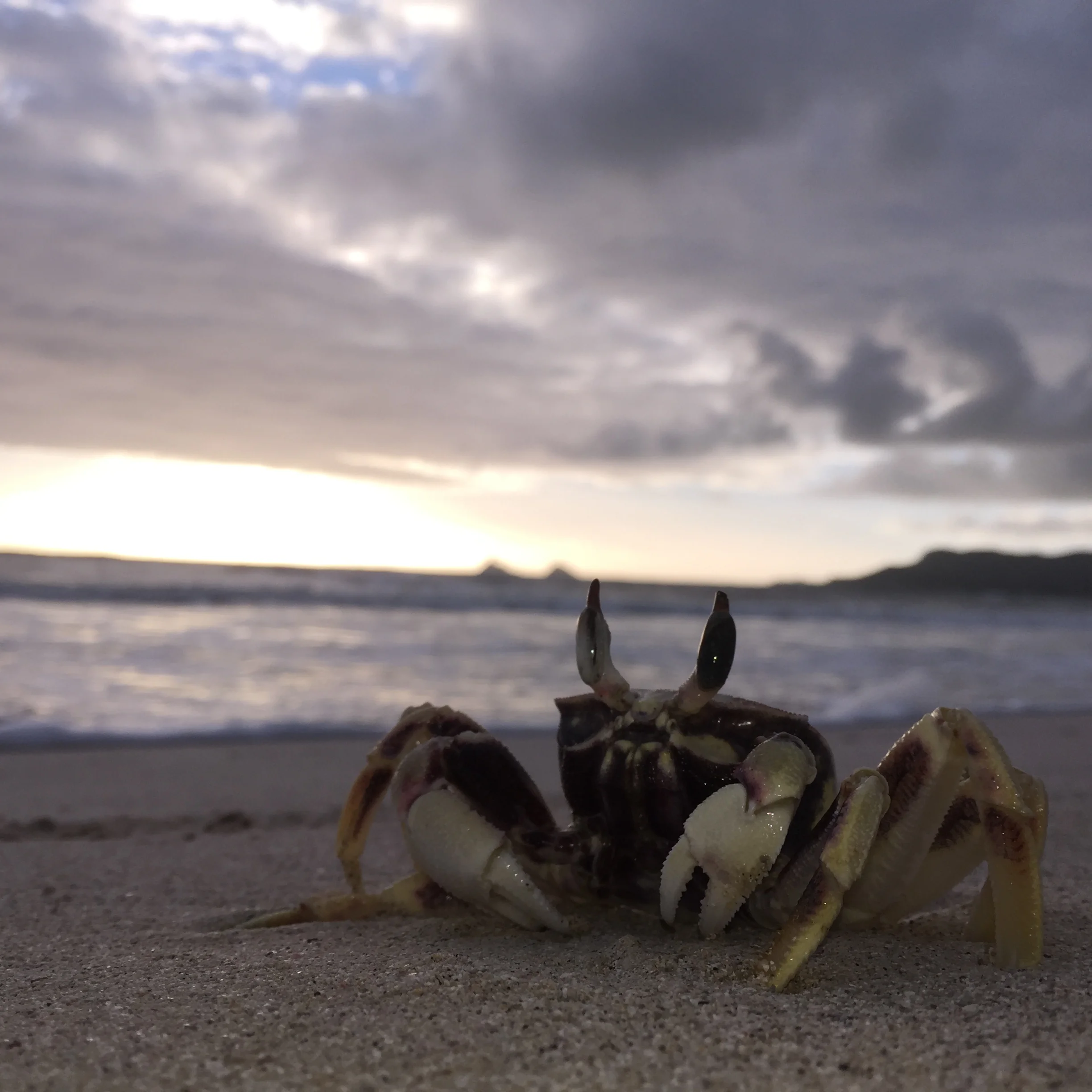
Interview with an 'Ohiki [Crab]
We met on a dogwalk. I bent down and snapped a photo, unsure if it was still alive. A claw moved. I took more photos. The dogs and I continued our walk, reached the end of the beach and began the trek back. The crab had moved slightly but it was still there. I saw the Mokuluas (two islands) in the background and I wanted very badly for the crab and the Mokes to balance each other out. I think the crab gave a very good interview.
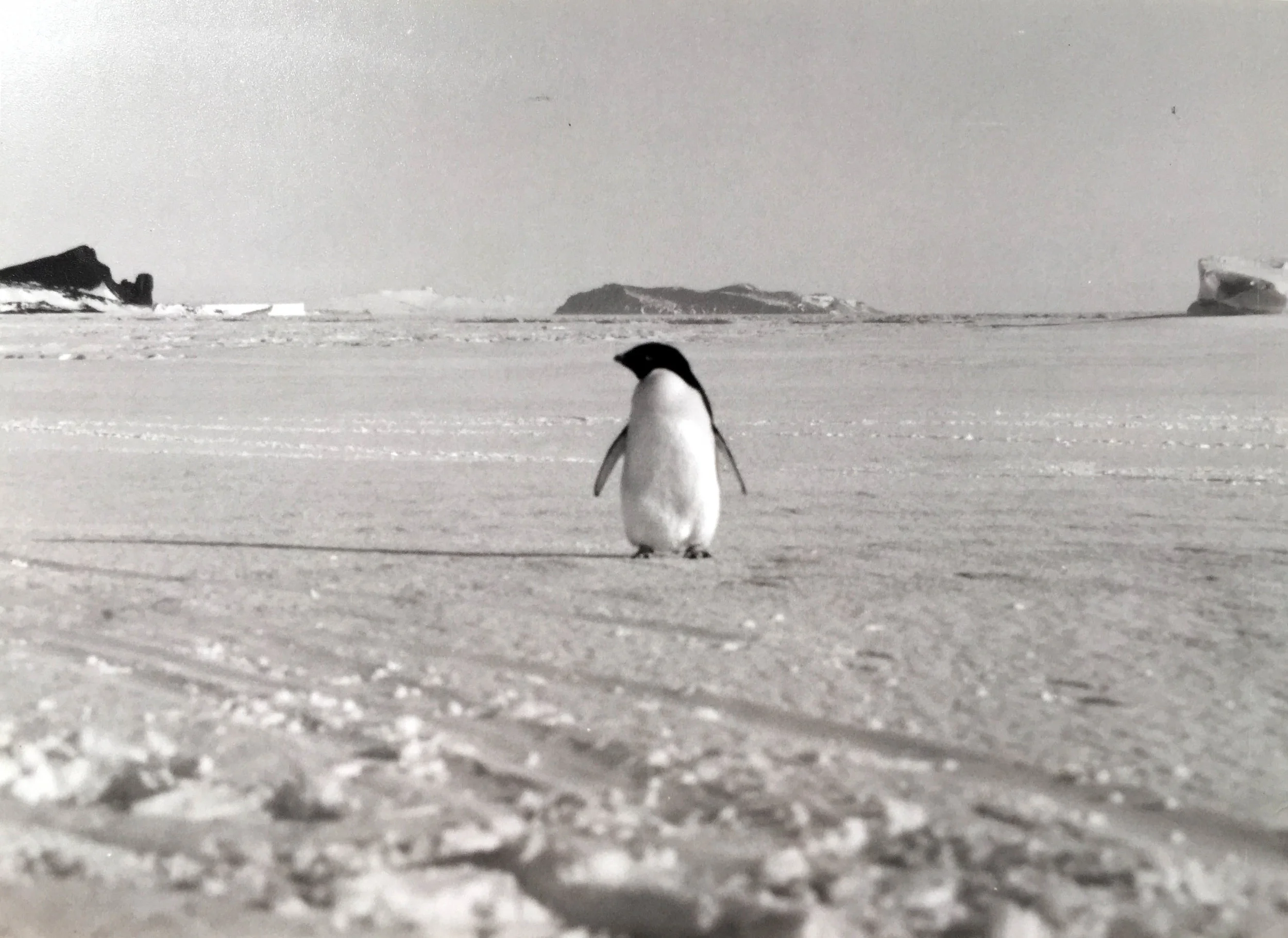
Twenty-year old Penguin Tracks bring Holiday Greetings | Throwback Thursday
Being in the field, out in nature, whenever, wherever inspires creativity like nobody's business. Today's Throwback Thursday is back to the 1990s, when I created a holiday card inspired by my encounter with penguins in Antarctica. The card, called Snow Angels, is still available in my online store for the almost 1990s era price of $3.45.
Sketching & Writing in Monterey
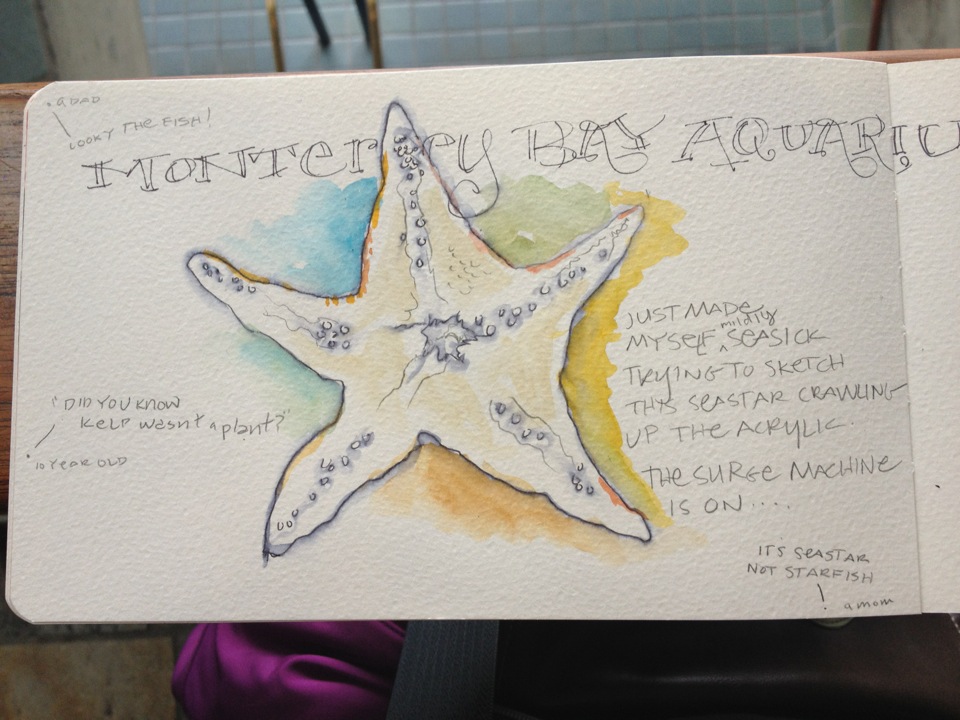
Here’s some of the creative output during my visit to Monterey Bay (July 24 to Aug 1, 2012)
WRITING EXERCISE with Jaci and Miki at The Clement in Monterey. | 10 minutes of free writing on THINGS I KNOW on July 27th
The knowledge I’ve acquired since last I wrote about this has certainly grown. I know Monterey will always be home tho I currently live several thousand miles away. But that is not the learning-kind of knowledge, that is the wisdom-style that comes with years of experience of life, people and places. I know that my passion of wanting to make a difference on the planet is still super strong and that I’m pretty darn sure it involves sharing my stories. I know that Butt-in-Chair is the process that helps me produce things. I know it’s hard to write while the guy in the next room expounds, “He’s got style, man!” and clinks his silverware. I know that we are limited by a lifetime on this planet—each of us on our own timeline that we need follow/listen/be guided by our muse—that muse will guide us—hopefully smoothly to new heights. Things I know, and I know things. Ich kenne Dinge. I know some German, some people. some math, something about marine biology and Antarctica, seals and whales and spiny little invertebrates. I know, without a doubt, I am super grateful to be here where I am, knowing the things I know, with these people, right here, right now.
Sketching and recording what I hear from visitors while at Monterey Bay Aquarium, July 27th, 2012.
THIS POEM came out while staying on a friend’s boat. It was like camping at an RV park but much better. [date unknown]
SENSES OF THE OCEAN
Sea lions barking
Seagulls squawking
Tight formation of brown pelicans fying overhead
The breath of a sea lion as it surfaces by the boat
Slap of flipflops
The wetness of fog on my skin
Tourists crowding the rec-trail
Sand on the feet
Cold, wet & salty
Kayaks
Dolphins outside the kelp forest
The smell of the sea which is moist and pure and ionic
Waves rushing up the beach
Noticing the different tides are doing their thing
The rock of a boat
The slap of mast wires
Looking thru the sea surface at a seal swimming by underwater
Cold water on hands
The temperature differential between sun and fog
Blue of sky and sea
More sketching of the views around the aquarium. July 27th, 2012
Me, Jon and Cecilia (Rosemary and Stacey not pictured) doing a little sketch crawl at Cannery Row Brewing Company, July 27, 2012
Sharing Art with Our Elders
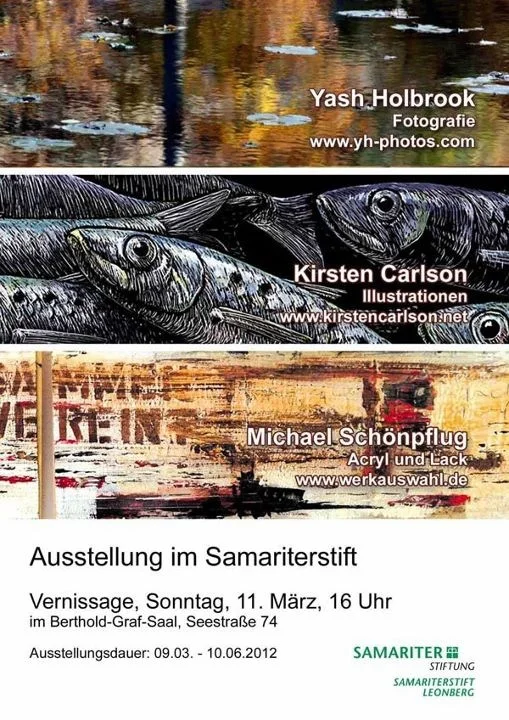
Michael Schönpflug organized a 3-person show at the local retirement home in Leonberg. I was fortunate to be one of the featured artists! Michael is a painter who owns an art gallery in Leonberg called, Der Kunstclub. Yash Holbrook photographs things that capture his eye while traveling, in nature and picks out the extra ordinary beauty in detail. Twenty percent of our sales went to help support the Samariterstiftung.
Subtidal Passage | Kunamokst Mural Mosaic Project
Mural in its permanent home at Galiano Inn & Spa on Vancouver Island, British Columbia.
Two hundred artists from the west coast and across N. America collaborated to create a huge mural of an Orca mother and calf. The mural is a mosaic of 231 original paintings by artists neither knowing one another, nor what the final image would be. Artists as young as 16 years to over 90 years old contributed their work pro bono to be a part of this amazing project.
I may hold the award for the furthest afield artist in this mural (Stuttgart, Germany), and am forever thrilled to be a part of this project because of the theme (Orca, my marine biologist totem animal), the meaning behind the Chinook word, Kunamokst (Together, unity thru diversity), and being in the company of some amazing artists (including Robert Bateman).
I have a permanent home in Gig Harbor, Washington but as a military spouse with wanderlust, we currently live in Germany. This mural has a permanent home at Galiano Inn & Spa on Vancouver Island. It was unveiled at the 2010 Winter Olympics in Vancouver, Canada.
Check out the Kunamokst website for more information and to order a limited edition print or DIY Kunamokst Mural book: www.kunamokstmural.com
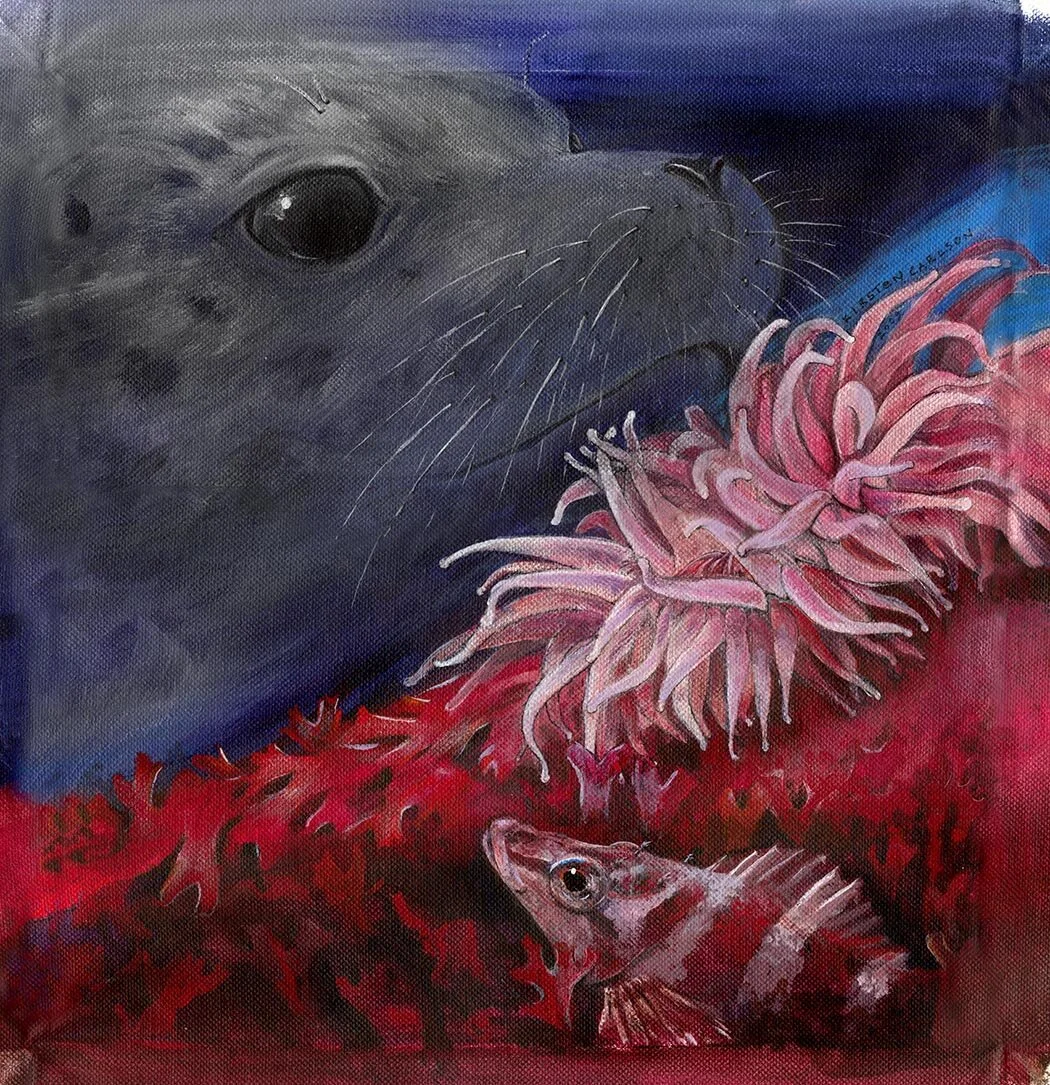
Subtidal Passage © 2010 Kirsten Carlson | acrylic, unstretched canvas, 12 x 12 inches
These are familiar friends, anytime I go diving on the West coast. I sometimes glimpse Harbor seals (Phoca vitulina) cruising past my bubbles, but most often I see them napping just above the waves on nearshore rocks. And, although Painted Greenlings (Oxylebius pictus) blend in unbelievably well with their surroundings, I can spy them when they dash from spot to spot amongst the swaying red algae (Rhodymenia spp). The Fish Eating Anemones (Urticina piscivora) appear like ghostly white flowers in the underwater landscape. They have an interrelationship with Painted Greenlings just like some anemones in tropical seas have with clownfish. I am grateful for each dive-adventure I take, because each time I see something new and wonderful in the underwater realm of the sea.
How was each tile made? These 4 images show the progress for tile #166. Every artist received an image (left), they were instructed to replicate the colors and pattern of the tile without knowing the final image.